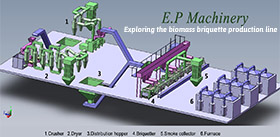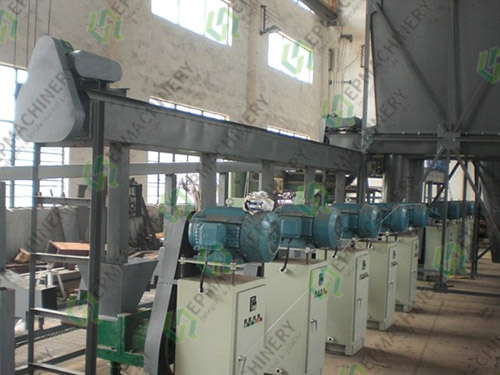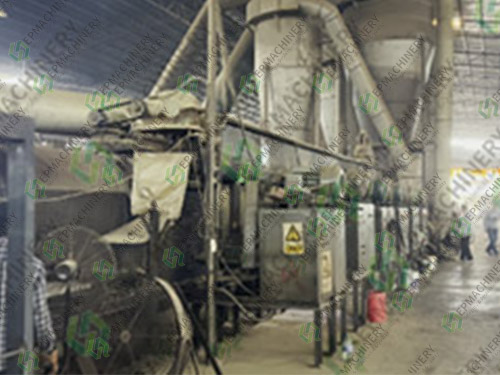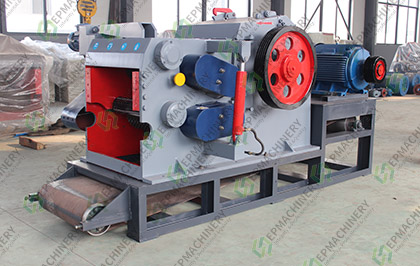
There are Four Key Points in Biomass Briquetting & Carbonizing industry. Many newcomers in this industry do not understand these four technical difficulties, they invested a lot of money to build factory, purchase equipment, etc., and spent a lot of energy and time, but they cannot produce qualified products finally. Please be sure to well study the technical difficulties of Biomass Briquetting & Carbonizing industry in detail before purchasing equipment, and do not invest blindly.
Choose appropriate biomass raw materials
Theoretically, all kinds of biomass materials are suitable. But, for different materials, the resulting briquettes will be different. Normal wood logs or branches are good materials. Straw, rice husk, and other agricultural wastes are not good, the resulting briquette has low calorific value and high ash content. Furniture wastes or pallet wastes which were processed, and hard shells are not easy for briquetting. Pinewood, cypress wood, rubber wood, etc. contain a lot of oil, which will result in being compressed into pieces, not long briquettes.
Good biomass raw materials are the basis for making good biomass briquette or charcoal briquette with high fixed carbon, low ash content and long burning time.
Moisture content of raw materials must be suitable
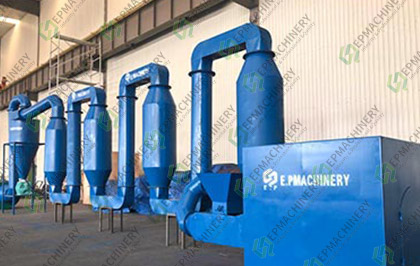
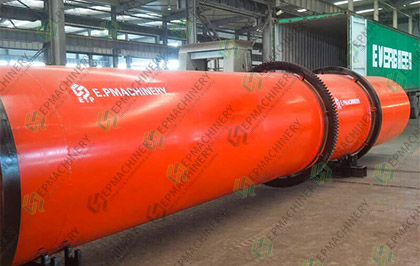
The appropriate moisture content of raw material for briquetting is 8%-12% roughly, so it will need a dyer to strictly control moisture content. Hot Air Dryer is cheap and suitable for small plant. For big plant with capacity more than 1000kg/h, Rotary Drum Dryer can be matched. Drying process is very important, excessive moisture content in raw materials will result in failure to produce briquettes and may result in explosions due to too much high temperature steam which will be produced inside mould.
Confirm the appropriate temperature of briquetting
Biomass material briquetting, a process to compress biomass material into solid briquette under high temperature and high pressure. Biomass materials contain a large amount of lignin which has a bonding function at high temperature to bind particles together, so high temperature is another basis for making strong solid briquette.
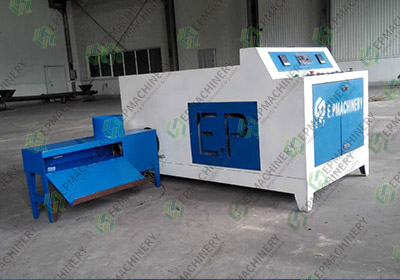
For different raw materials or different diameter of briquette, the appropriate temperature will be a bit different. So we need to find the most appropriate temperature for specific raw material. Before starting production, adjust the heating temperature to about 380 degrees, check the temperature controller, start motor and feed raw materials when the temperature reaches. As briquettes come out slowly, temperature will go down a bit. If no strong briquettes coming out smoothly, we can try to adjust temperature a bit higher. If the surface of resulting briquettes burns a lot, we need to adjust temperature a bit lower. When the qualified briquettes come out, check the data on temperature controller, this is just the most appropriate temperature for this specific raw material. During the briquette is normally produced, the temperature is usually around 300-350 degrees, the qualified briquette has Deep Yellow color, high density and strength.
Confirm the appropriate angle of screw propeller
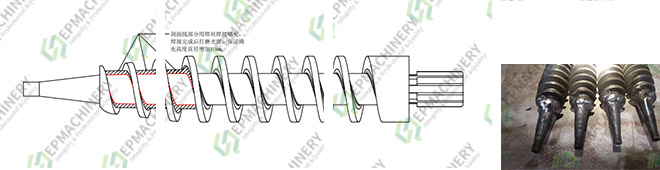
Biomass material briquetting is a process to compress biomass material into solid briquette under high temperature and high pressure, and screw propeller is just the device to provide high pressure. For different raw materials, the suitable angle and thickness of screw can be a bit different. So we need to find the most appropriate angle and thickness of screw according to our specific raw materials, to produce the qualified briquettes with high density and strength.
The screw propeller is a quick-wear part, we need to weld and polish it when it is wearing, then it can work again. We suggest to use our special Alloy Welding Rod, heat screw propeller to high temperature first, then weld the screw propeller, and finally polish surface to be smooth.
If carbonization is used, it must be equipped with a flue gas recovery system
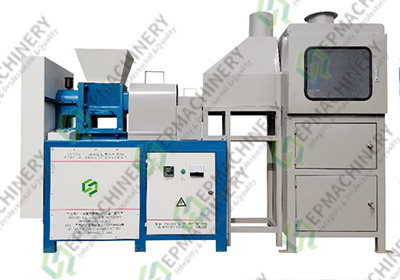
For both Drying process and Carbonizing process, fuel is necessary to provide heat, so they will need a large amount of fuel, in other words, a large amount of cost. Therefore, the carbonizing process must have smoke recycling system. During biomass is carbonizing, there is much smoke generated from biomass, the smoke consist of combustible gas (CO, CH4, O2, etc.), wood vinegar and tar, dust, etc. Smoke recycling system will separate the mixtures, so we get purified combustible gas and by-product (wood vinegar and tar). Purified gas can be reused as fuel for drying process and carbonizing process, which will save much money for fuel.
There is also much smoke generated from briquetting process, so we suggest an integrated smoke recycling system to cover both briquetting process and carbonizing process, which will be more efficient, environmentally friendly and saving cost.
EP MACHINERY has been manufacturing Biomass Briquetting and Carbonizing Machinery for nearly 30 years, and has accumulated a lot of experience in this industry. If you are interested in building a factory for biomass briquetting and carbonizing, or you have this factory already but can’t produce good biomass briquettes or charcoal briquettes, please contact us, we will provide you with perfect solution.